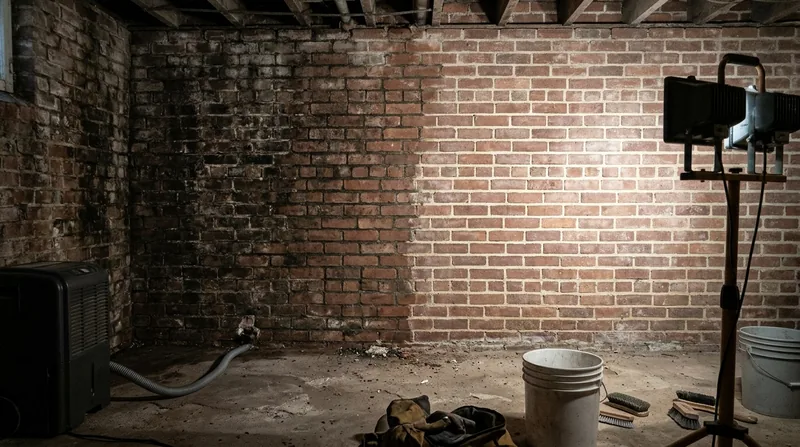




Basement Mold Remediation in Gastonia: Fix the Moisture, Then the Mold
If you are searching for Basement Mold Remediation in Gastonia, you already know the musty smell is not going to leave on its own. Gaston County sits on the rolling Carolina Piedmont between the Catawba and South Fork rivers, and the thick red clay and saprolite under our neighborhoods hold water and swell with every summer thunderstorm. That moisture pushes against foundation walls, finds old brick mortar joints in York-Chester Craftsman homes, and creeps into the partial basements of 1950s brick ranches in Belmont and Mount Holly. Mold needs three things: moisture, organic material, and time. We handle all three. Our work starts with finding the water source, not just spraying the visible growth. Call (980) 448-7213 to schedule a free basement inspection, or review our basement waterproofing service to understand the full moisture-control picture.
Why Basement Mold Grows So Fast in Gastonia Homes
Gastonia's humid summers and heavy tropical downpours create a moisture load that older basements were never designed to manage. The 1900s brick foundations in the York-Chester historic district and the mill-village houses around the old Loray and Firestone mills were built with lime mortar and rudimentary footing drains, and many have partial basements cut into sloped lots. Water from uphill yards runs toward those walls, and the red clay keeps it there. Once relative humidity in a basement stays above 60 percent, mold colonizes paper-faced drywall, wood framing, and stored cardboard within days.
The patterns we see most often in Gaston County:
- Efflorescence and wall seepage appear as white powder on brick or block, signaling moisture moving through the wall.
- Musty basement smell lingers after rain because humid air has no path out and no dehumidification.
- Sump pump failure during a summer storm leaves standing water that wicks up into framing and insulation.
- Hydrostatic pressure forces water through hairline cracks and cold joints in poured-concrete walls near Lake Wylie.
- Poor grading and short downspouts dump roof water against the foundation instead of away from it.
Treating the mold without correcting the moisture source guarantees it returns by the next wet season.
Key info: A split-level home in Belmont with a lower level cut into a slope often shows mold on the uphill wall only. That is not a ventilation problem. It is groundwater entering through the wall and footing joint, and it needs a drainage fix before any surface treatment.
For official guidance on moisture and mold in buildings, the U.S. Environmental Protection Agency publishes a concise homeowner resource at epa.gov/mold. The core message matches ours: control the moisture and you control the mold.
How We Run Basement Mold Remediation in Gastonia
Our process follows a fixed sequence because skipping steps is how mold jobs fail. We begin with a moisture assessment: pin-type and non-invasive meters on walls, floor slab, and framing, plus a humidity reading and a look at how water is entering. Then we build containment so spores do not spread to the rest of the house. Remediation of affected materials comes next, followed by drying, and only then do we install the permanent moisture-control measures that keep the basement dry. The order matters. A dehumidifier running in a basement with an active wall leak is just an expensive way to dry the yard.
- We inspect the basement and document moisture readings, visible growth, and the water entry points.
- We set up containment with poly sheeting and negative air pressure to isolate the work zone.
- We remove porous materials that cannot be cleaned, such as saturated drywall, insulation, and cardboard.
- We HEPA-vacuum and treat structural surfaces with an antimicrobial product approved for the substrate.
- We dry the space with commercial dehumidifiers and air movers until readings return to normal.
- We correct the water source, which may mean sealing cracks, extending downspouts, or installing an interior perimeter drain.
Every job ends with a moisture reading and a walkthrough so you can see exactly what changed.
Key info: A 1990s walk-out basement near Crowders Mountain had mold on the lower two feet of the uphill wall and a musty smell through the whole lower level. The cause was a failed footing drain and a downspout discharging within 18 inches of the wall. We remediated the affected drywall, treated the framing, and corrected the drainage. The basement has stayed dry through two hurricane-season remnants since.
When the source turns out to be chronic wall seepage rather than a single event, we often pair remediation with an interior drain tile system that captures water at the footing and routes it to a sump basin. That is the permanent fix, and it is usually less disruptive than exterior excavation.
Remediation and Moisture-Control Methods We Use
Not every basement needs the same approach. A single crack that weeps after heavy rain is a different job from a wall that is damp year-round because the water table sits high against it. The table below shows how we match the method to the condition, and we will tell you plainly when simple crack sealing is enough.
| Approach | Description | Best for |
|---|---|---|
| Containment and HEPA remediation | Isolate the work zone, remove porous materials, HEPA-vacuum and treat structural surfaces. | Visible mold on walls, framing, or stored contents after a leak or flood. |
| Crack injection and wall sealing | Epoxy or polyurethane injection into cracks, plus a breathable or cementitious wall coating. | Localized seepage through hairline cracks in poured or block walls. |
| Interior perimeter drain and sump | Drain tile at the footing perimeter feeding a sump basin with a pump and check valve. | Hydrostatic pressure and water rising at the wall-floor joint. |
| Dehumidification and ventilation | Correctly sized dehumidifier and humidity monitoring to hold the space below 60 percent. | Humid summers and basements that stay damp without standing water. |
| Grading and downspout correction | Regrade soil to slope away and extend discharge lines well past the foundation. | Roof water concentrating at the uphill wall on sloped Gaston County lots. |
We choose the least invasive method that actually solves the moisture problem, and we explain the reasoning before any work begins.
Basement Mold Remediation Cost in Gastonia: What to Expect
Remediation pricing starts at From $1,500 for a contained job with limited affected area, and it climbs from there based on square footage, how many materials have to be removed, and whether drainage work is part of the fix. A small area of surface growth on a block wall in a Lowell ranch is a different number than a finished basement in Cramerton with saturated drywall and framing that needs drying. We give you a written scope with the moisture readings attached so the number is tied to conditions, not guesswork.
The factors that move the price most:
- The square footage of affected wall, floor, and ceiling area, measured during inspection.
- Whether porous materials like drywall and insulation must be removed and replaced.
- Whether the water source needs a drainage correction such as crack injection or an interior drain.
- Access to the basement and whether contents must be moved and protected.
- How quickly the job needs to happen, since emergency response carries scheduling pressure.
Get two or three estimates and compare the scope, not just the total. A low bid that skips the moisture source is not a bargain. Our full pricing overview breaks down the ranges by service.
Basement Mold Remediation Near Me: How to Vet a Contractor Near Gastonia
Mold work in North Carolina is not a licensed trade the way electrical or plumbing is, which means anyone with a sprayer can advertise. Protect yourself by asking direct questions. Confirm general liability and workers' compensation coverage and request a certificate of insurance before work starts. Ask for local references from jobs in Gaston County and call them. Find out whether the contractor will handle the moisture source or just treat the surface. And ask who pulls any permit if structural or drainage work is involved, since the local building department sets those rules and they vary by jurisdiction.
We are a Basement Health Association (BHA) member and carry insurance; we provide a certificate on request. We also give you a written scope and a transferable warranty on the work. When you are ready to talk, reach out through our contact page or call (980) 448-7213. We will tell you honestly whether you need full remediation or a simpler moisture fix, and we will not sell you a drainage system if a downspout extension solves the problem.
Basement Mold Remediation in Gastonia: Pricing Guide
| Service | Price | Details |
|---|---|---|
| Contained mold remediation | Starting at $1,500 | Includes containment, HEPA vacuuming, antimicrobial treatment, and drying for a limited affected area. |
| Remediation with material removal | Starting at $2,800 | Adds removal and disposal of saturated drywall, insulation, and framing cleanup in a finished basement. |
| Remediation plus drainage correction | On estimate | Combines surface treatment with crack injection or interior drain work, priced after the inspection. |
| Emergency response | On estimate | After-hours scheduling and rapid drying setup after a storm or sump failure; urgency drives the number. |
| Travel | Included | In Gastonia and surrounding Gaston County cities, no separate call-out or mileage fee. |
| Estimate | Free | Response within 24 hours at (980) 448-7213, no obligation to book. |
Indicative pricing, the exact cost depends on square footage, finish, and site access. Free personalized estimate within 24h at (980) 448-7213.


