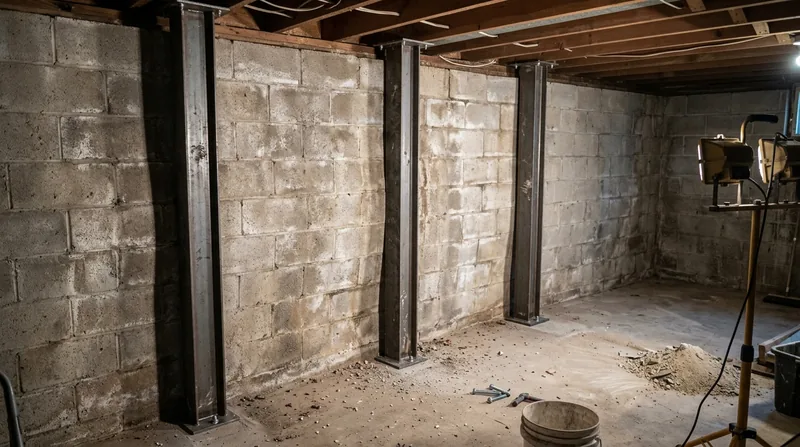




Bowing Wall Repair in Gastonia: When Saturated Red Clay Starts Pushing
If you own a brick Craftsman near the York-Chester historic district or a 1960s split-level in Belmont, you already know what Gaston County clay does after a week of summer storms. Bowing wall repair in Gastonia is the work of stopping a foundation wall that has started to lean inward under hydrostatic pressure, and we have seen it in every housing stock this county has. The Carolina Piedmont sits on thick red clay and saprolite that swell when wet and shrink when dry, and sloped lots near Crowders Creek and the South Fork push runoff straight at the uphill wall. That is why a wall that looked plumb in April can show a visible belly by September. We stabilize the wall with carbon fiber straps, steel I-beams, or wall anchors matched to the movement and the soil, and we tell you honestly when a crack is the real problem and the bow is cosmetic. Start with a foundation crack repair assessment if you are not sure which issue you have.
Why Bowing Walls Are a Gastonia Problem, Not a Cosmetic One
Gastonia sits on rolling Piedmont ground between the Catawba and the South Fork, and the clay under most of these lots holds water like a sponge. When a block or poured wall on the uphill side of a split-level takes on saturated clay, the pressure has nowhere to go but inward. Historic mill-village houses around the old Loray and Firestone sites were built with shallow footings and no modern drainage, so they feel it first. Homes on the Lake Wylie slopes in Mount Holly and Cramerton see it after tropical downpours dump inches in an afternoon.
- Hydrostatic pressure builds when red clay stays saturated for days after a storm.
- Original footing drains from the 1920s and 1950s are often crushed, clogged, or simply gone.
- Downspouts that dump at the foundation corner soak the same soil year after year.
- Tree roots from oaks and tulip poplars pry at block joints and open paths for water.
- Freeze-thaw cycles in a Piedmont January widen existing hairline cracks into real movement.
Each of those failure modes points to a different repair, and guessing wrong wastes money.
Key info: A 1920s brick Colonial Revival on a York-Chester lot can show a two-inch bow at mid-wall while a 2005 walk-out off South New Hope Road shows the same bow in a poured wall. The cause is the same saturated clay, but the anchor pattern and strap layout are not.
Local code and structural repair permitting run through the City of Gastonia building department, and you can verify current requirements at gastonianc.gov before any structural work begins.
How We Diagnose and Stabilize a Bowing Wall in Gastonia
We start by reading the wall, not by selling a system. A plumb line and a level tell us how far the wall has moved and in which direction. Efflorescence and horizontal cracking tell us whether water is the driver. From there we match the repair to the severity, because a one-inch bow in a 1950s ranch in Dallas is not the same job as a three-inch bow in a walk-out basement near the South Fork.
- We measure the bow with a plumb line and record crack widths and direction at several heights.
- We check the exterior grade and downspout discharge to see where the water is entering the soil.
- We confirm whether the movement is active or has stabilized over the past season.
- We specify carbon fiber straps for moderate bowing, steel I-beams for heavier loads, or wall anchors where the exterior is accessible.
- We install the system, torque anchors or straps to spec, and re-check the plumb line before we leave.
- We address the water source with grading, downspout extensions, or an interior drain tile system so the repair is not fighting the same pressure next year.
Stabilization without water control is a temporary fix, and we say so up front.
Key info: On a 1958 brick ranch in Belmont, the uphill wall had bowed about an inch and a half after years of a downspout dumping at the corner. Carbon fiber straps plus a downspout extension and regraded soil stopped the movement, and the homeowner avoided excavation entirely.
Repair Methods We Match to Your Wall and Soil
No single method fits every bowing wall, and the right choice depends on how far the wall has moved, what the wall is made of, and how much room you have on the exterior. Here is how the main approaches compare on Gaston County jobs.
| Approach | Description | Best for |
|---|---|---|
| Carbon fiber straps | Epoxy-bonded straps span from floor to ceiling joist and resist further inward movement. | Moderate bowing up to about two inches, with no exterior access needed. |
| Steel I-beams | Vertical beams set against the wall and tied into the floor and joists. | Heavier bowing, block walls, and walls that must be straightened over time. |
| Wall anchors | Exterior anchor plates pull the wall back through rods and interior plates. | Walls that need active pulling, where the exterior grade allows excavation. |
| Epoxy or polyurethane injection | Ports are set along the crack and resin is injected to seal it. | Crack sealing where the wall is not bowing, as a complement to stabilization. |
| Water control and drainage | Grading, downspout extensions, and drain tile reduce the pressure driving the wall. | Every bowing wall job, because the water source has to be managed. |
Most Gastonia jobs use one structural method plus a water-control fix, and we confirm the combination during the inspection.
Bowing Wall Repair Cost in Gastonia: What to Expect
Homeowners ask about bowing wall repair cost before anything else, and the honest answer is that the range is wide. A single-wall carbon fiber strap job on a 1950s ranch in Ranlo starts at From $600 for a limited scope, while a full anchor system on a walk-out wall in Mount Holly runs several thousand. The number depends on how far the wall has moved, the wall material, how many linear feet are involved, and whether exterior excavation is needed. Access matters too: a tight side yard behind a crape myrtle hedge costs more to work around than an open slope.
We recommend two or three written estimates on any structural repair, and we give you a scope you can compare line by line rather than a single lump figure. Our pricing page lays out the detail behind the starting figures. Ask each contractor whether the water source is included, because a structural bid that ignores the saturated clay will not hold.
Choosing a Bowing Wall Repair Contractor Near Gastonia
Finding a contractor near Gastonia who actually specializes in below-grade work is harder than it should be, because general foundation firms and general handymen both advertise wall repair. Ask what method they plan to use and why, and ask for references on jobs like yours, not just any job. A contractor who cannot explain why carbon fiber fits your bow and not another method has not looked closely enough.
- Confirm the contractor is licensed and insured and ask for a certificate of insurance before work starts.
- Get two or three written estimates with the method and scope spelled out.
- Ask for references from Gaston County jobs with a similar wall and soil condition.
- Ask who pulls the permit if the work is structural, since the City of Gastonia building department sets the requirement.
- Check whether your HOA in a newer Lake Wylie subdivision has rules on exterior excavation or equipment access.
We are a Basement Health Association member, and we are happy to walk you through a free estimate with no pressure to book.
Key info: A homeowner in Lowell got three bids on a bowing block wall. Two quoted excavation and a full exterior system; the third measured the bow at under an inch and recommended carbon fiber straps with drainage correction at a fraction of the price. Measure first, then price.
Bowing Wall Repair Near Me: What Gastonia Homeowners Should Know
When you search for bowing wall repair near me in Gastonia, you will find a mix of national franchises, general foundation firms, and local waterproofing specialists. The difference that matters is whether the crew diagnoses the water source or just bolts a strap to the wall. Saturated red clay is the engine behind most of these failures in Gaston County, and the repair has to account for it. We work the whole below-grade picture: the wall, the footing drain, the grading, and the discharge. Call (980) 448-7213 and we will tell you plainly whether you are looking at a structural repair or a sealing job.
Bowing Wall Repair in Gastonia: Pricing Guide
| Service | Price | Details |
|---|---|---|
| Carbon fiber strap installation, single wall | Starting at $600 | Covers moderate bowing on one wall; number of straps and wall length move the price |
| Steel I-beam stabilization | Starting at $1,800 | Heavier bowing or block walls; beam count and floor-to-joist tie-in drive the figure |
| Wall anchor system | Starting at $3,500 | Exterior excavation access, anchor spacing, and wall length set the final cost |
| Crack injection add-on | Starting at $450 | Epoxy or polyurethane injection along active cracks, priced by linear feet |
| Drainage correction with repair | On estimate | Grading, downspout extensions, or drain tile quoted after the on-site look |
| Estimate | Free | Response within 24h at (980) 448-7213, no obligation to book |
Indicative pricing, the exact cost depends on square footage, finish, and site access. Free personalized estimate within 24h at (980) 448-7213.


